August 12, 2026
Behavioral biometrics and voice biometrics both get filed under “invisible fraud prevention,” and both get pitched as the layer that stops account takeover without adding friction to the customer. They are not interchangeable. One reads how a person physically interacts with a device. The other verifies who is speaking and what they actually authorized. As payment fraud shifts toward voice-channel social engineering and, increasingly, AI agents acting on a customer’s behalf, that difference stops being academic and starts being the whole ballgame.
What is the difference between behavioral biometrics and voice biometrics?
Behavioral biometrics passively scores a session based on physical telemetry: keystroke cadence, touchscreen pressure, swipe velocity, device tilt. It answers a narrow question: does this session look like it’s being operated by the human who normally holds this device? Voice biometrics analyzes the voice itself, verifying speaker identity, detecting synthetic or cloned audio, and in more advanced implementations, cryptographically binding a verified voice to a specific transaction. It answers a different, larger question: is this the right human, and did they actually authorize what’s about to happen?
The two technologies were built to catch different things. Behavioral biometrics was designed to catch a bot or a stolen device operating a mobile banking session. Voice biometrics was designed to catch an impersonator, a deepfake, or a coerced authorization on a call. Payment fraud increasingly runs through the second path, not the first.
Where does behavioral biometrics have no visibility at all in payment fraud?
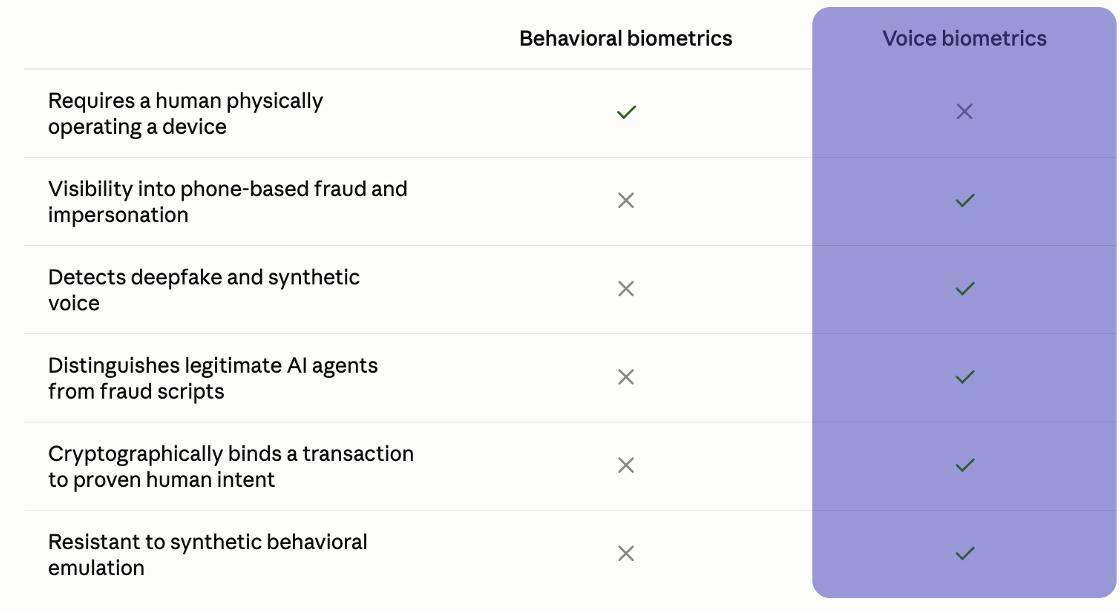
Phone calls. A huge share of payment fraud today starts with a voice: a fraudster impersonating a bank’s call center, a cloned voice authorizing a wire transfer, a scripted social engineering call talked past a contact center agent. Behavioral biometrics has zero visibility into any of it, because none of it happens inside a device session it can measure. Its telemetry starts and ends at the screen.
Voice biometrics starts exactly where behavioral biometrics stops. Voice Verity® detects synthetic and cloned audio on a call in real time, catching impersonation attempts before they reach a transaction. VoiceID™ checks the caller against known fraudster voiceprints, flagging repeat offenders even from a new number or device. And for high-value or sensitive transactions, VoiceMFA™ requires the account holder to confirm the specific transaction aloud, verified against their enrolled voiceprint, producing a cryptographic, non-repudiable record of exactly who authorized what.
Deepfake voice technology already contributes to roughly one in eight successful scams tracked in recent research, and that share only grows as generative voice tools improve. A fraud stack with no visibility into phone-based fraud is a fraud stack with a growing blind spot at its center.
Can behavioral biometrics tell a legitimate AI agent from a fraud script?
No, and this is the gap that matters most going forward. Both a fraud bot and a customer’s authorized AI assistant execute transactions programmatically, through APIs or automated scripts, with zero keystrokes, zero swipes, zero touchscreen pressure to measure. Behavioral biometrics has no physical telemetry to read from either one, so it cannot distinguish a malicious script from a legitimate agent acting under delegated authority. Generative AI can now synthesize convincing interaction telemetry too, typing latency, mouse jitter, natural touch curves, which erodes even the passive-session cases behavioral biometrics was built for.
Voice biometrics solves this differently. Instead of trying to infer legitimacy from behavior a machine doesn’t exhibit, it verifies the human who authorized the agent’s mandate in the first place, then cryptographically binds that authorization to the action the agent goes on to execute. The agent doesn’t need to behave like a human. The human’s intent just needs to be provably attached to what the agent does.
Voice vs. behavioral biometrics: a side-by-side comparison
Why is voice the better long-term investment for payment fraud prevention?
Because payment execution is moving away from the exact interaction pattern behavioral biometrics depends on. Conversational commerce, voice-initiated payments, and autonomous AI agents all remove the keystrokes and swipes behavioral biometrics was built to read. Voice does not have that dependency. Whether a person calls a contact center directly, authorizes a payment by voice, or delegates execution to an AI assistant, there is still a voice moment somewhere in the chain where identity and intent can be verified and locked to the outcome.
That is also why voice scales further than behavioral biometrics on its own. A unified voice trust platform can verify identity, detect synthetic audio, and bind intent to a transaction across every channel a customer might use, contact center, IVR, app-based voice authorization, agent delegation, inside one architecture. Behavioral biometrics stays confined to the mobile or web session it was built to monitor and needs a separate point solution stacked on top for everything else.
What should replace behavioral biometrics as the primary fraud control?
A voice trust platform built around three questions, not one. ValidSoft’s AI Voice Identity Platform (VIP™)structures this as layered controls:
Is it a real human? (Voice Verity®) Detects synthetic speech, voice clones, and deepfake audio in real time, across any channel, without enrollment or stored PII.
Is it the right human? (VoiceID™) Verifies speaker identity passively during natural conversation, matching against known voiceprints or fraud watchlists to eliminate account takeover.
Is it the right outcome? (VoiceMFA™) Cryptographically binds a verified voiceprint to a specific transaction or command, creating an immutable, non-repudiable audit trail that behavioral biometrics has no equivalent for.
Behavioral biometrics answers a version of the first two questions, and only for sessions where a human is physically touching a device. It has no answer at all for the third. As more payment execution shifts to voice channels and autonomous agents, that third question is the one that determines whether a fraud control still works.
FAQs
Is behavioral biometrics obsolete? Not entirely. It still adds a useful passive layer to human-operated mobile and web banking sessions. It loses all signal the moment a transaction is initiated by voice or executed by an AI agent, because there is no physical device interaction left to measure.
Does behavioral biometrics work for AI agent transactions? No. It cannot reliably distinguish a legitimate AI agent acting under delegated authority from a malicious automated script, because neither produces the physical telemetry, keystrokes, swipes, touch pressure, that behavioral biometrics depends on.
What is voice intent binding? A cryptographic link between a verified human voiceprint and a specific transaction or instruction, producing a record that is provable, non-repudiable, and immutable. It is the layer behavioral biometrics has no equivalent for.
Which is better for stopping account takeover, voice or behavioral biometrics? Voice biometrics catches account takeover attempts that originate on a call, including impersonation and deepfake audio, before a transaction happens. Behavioral biometrics can flag anomalies in a session after the fact but cannot verify who is actually speaking or what they intended.
Can voice biometrics replace behavioral biometrics entirely? For payment fraud prevention specifically, yes, since voice covers call-based social engineering, deepfakes, and AI agent authorization that behavioral biometrics cannot see at all. Many enterprises run both during a transition period, but the fraud vectors growing fastest, APP scams and agentic commerce, are ones only voice-based verification can address.
Real Human? Right Human? Right Agent? Right Outcome? Learn how ValidSoft closes the gap.