
 November 10, 2026
The short answer
On November 5, 2026, the U.S. Attorney’s Office for the Southern District of New York (SDNY) unsealed an indictment charging three men in an alleged $129 million global AI impersonation scheme. According to the indictment, the attackers did not hack a server or exploit a line of code. They used AI-cloned voices and, in some cases, deepfake video of CEOs and corporate attorneys to trick finance teams into wiring funds to accounts around the world.
This case marks a turning point for security leaders: a recognizable voice is no longer evidence of identity.
ValidSoft closes this attack vector at the signal level. Deepfake Detection answers “is this voice human?” and Passive Voice Biometrics answers “is this the right human?” Together they verify who is on the call in real time, before an employee acts on the request.
The SDNY federal indictment
- Prosecuting authority: U.S. Attorney’s Office, Southern District of New York (SDNY)
- Defendants: Jacob Soall, Sharon Hazan and Guy Sheetrit
- Charges: wire fraud, aggravated identity theft and money laundering
- Alleged period: July 2024 to February 2026
- Alleged losses: about $129 million, with thousands of victims targeted
- Alleged victims: an investment bank, a bank, two hospital systems, a fintech company, a mutual fund company and a pet food company, across the US and UK
The anatomy of the attack: the dual-impersonation playbook
The indictment describes a layered loop in which two fake identities vouched for one another. Nothing in steps 1 through 5 required defeating a firewall. It only required defeating human perception.
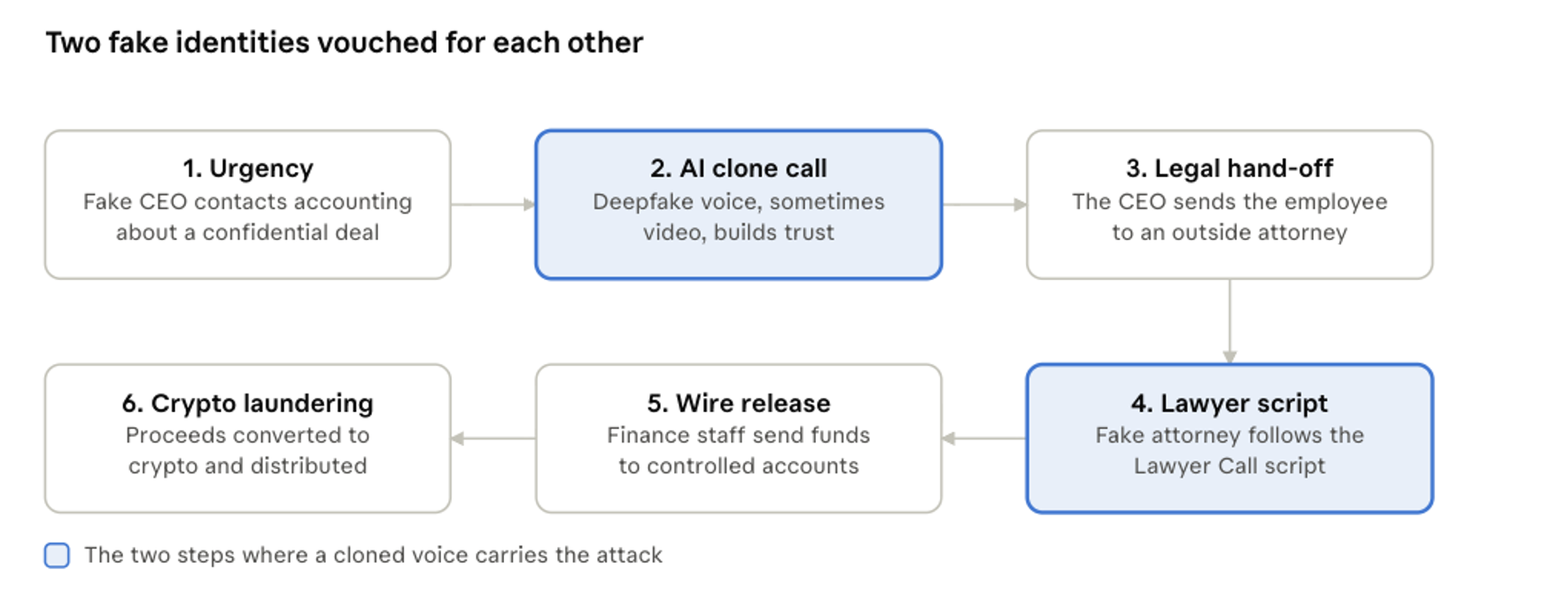
A cloned CEO opens the loop, and a fake attorney closes it, and the employee sees no technical warning at any step.
- The executive approach. The attacker poses as the CEO and raises an urgent, confidential financial transaction with an accounting employee.
- The deepfake reinforcement. An AI-generated voice, and in some cases video, mimics the CEO on a call to build trust.
- The “Lawyer Call” hand-off. The “CEO” tells the employee to work directly with an attorney at a major international law firm.
- Scripted legal pressure. An impersonated attorney works from a script titled “Lawyer Call” to make the transaction look legitimate.
- Fund dispersal. Relying on the voices and images they trust, finance staff wire funds to accounts the group controls.
- Laundering. The proceeds are allegedly converted to cryptocurrency and distributed.
Why legacy security fails under AI voice impersonation pressure
Enterprise security models heavily guard networks, applications and endpoints, but leave the voice channel unverified. The indictment exposes three fatal assumptions.
- Assumption: “We know our executives’ voices.” The reality: human voice recognition is easily tricked. Generative AI can clone a voice from audio executives already make public, such as earnings calls, interviews and keynotes.
- Assumption: “Our approval workflows will prevent fraud.” The reality: social engineering is designed to get around workflow checks. A convincing deepfake executive creates an artificial crisis that pressures employees to skip standard approvals.
- Assumption: “Security awareness training protects us.” The reality: training asks employees to spot synthetic audio that is increasingly indistinguishable from the real voice. Relying on human ears to catch it is an operational dead end.
The ValidSoft defense architecture
Stopping AI voice fraud means moving from perceptual trust (“it sounds like him”) to verified identity (“the signal is proven human and matched to the right person”). ValidSoft runs two checks inline across executive lines, help desks and contact centers, and a third on the payment itself.
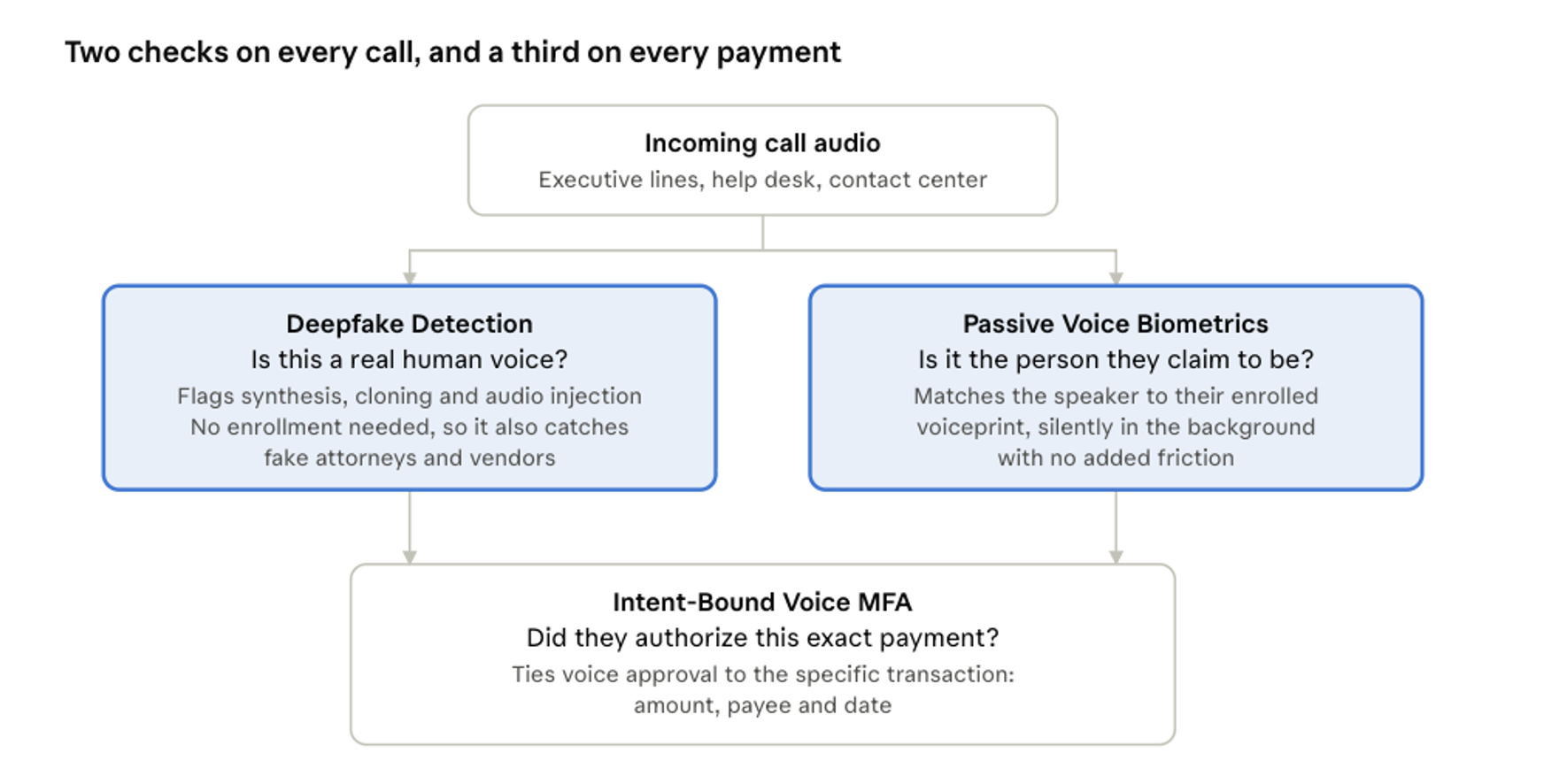
Step 1 – detection proves a real human is speaking. Step 2 –voice biometrics proves it is the right human, and Step 3 – intent-bound verification proves they authorized this specific payment.
- Synthetic voice and deepfake detection. Analyzes the audio stream in real time to detect voice synthesis, voice cloning and audio injection. Because it checks the nature of the signal rather than a profile, it also flags un-enrolled third parties, like the fake attorney.
- Passive voice biometrics. Matches the speaker’s voice to their enrolled voiceprint, silently in the background, with no passcodes or added friction for executives or staff.
- Intent-bound verification (Voice MFA). Binds voice authorization to the specific high-value transaction, such as the amount, payee and date, so only the authentic voice can authorize the wire.
Immediate action plan for security and finance leaders
- Audit unsecured voice channels. Review every channel where a voice command can trigger a financial transaction, credential reset or wire approval, including executive lines, IT help desks and treasury operations.
- Eliminate Single Points of Authority. Eliminate single-person wire authorizations based on a voice or video call alone, whoever the caller claims to be.
- Move from training to automated control. Replace reliance on employee judgment with real-time deepfake detection, voice biometric verification layers and cryptographic step-up voice MFA
Protect your voice channels today
Don’t wait for a cloned call to test your wire controls. Schedule a ValidSoft Voice Risk Audit to evaluate your exposure to synthetic voice attacks and see real-time deepfake detection on a live line.
Frequently asked questions
What is the SDNY AI deepfake fraud case?
It is a federal indictment unsealed on November 5, 2026, charging three foreign nationals with using AI to impersonate corporate executives and law firm attorneys. Prosecutors allege the scheme ran from July 2024 to February 2026 and defrauded companies of about $129 million. The charges are allegations, and the defendants are presumed innocent.
How did the fraudsters use voice cloning?
According to the indictment, they posed as a company’s CEO, used AI to mimic the CEO’s voice and sometimes image on a call, and told an employee to work with a lawyer on a confidential transaction. A second impersonator then played the lawyer and gave wiring instructions.
Which industries were affected?
The alleged victims include banks, an investment bank, hospital systems, a fintech company, a mutual fund company and a pet food company. The attack did not depend on the victim’s sector. It depended on an employee trusting a voice.
Why do trained employees still fall for executive impersonation calls?
Because the attack uses the signals employees are taught to respect: seniority, urgency, confidentiality and a familiar voice. When the voice is cloned, the main cue people used to confirm identity is the one that has been faked.
What is the difference between voice biometrics and deepfake detection?
Deepfake detection checks whether the audio is a real human voice or AI-generated. Voice biometrics checks whether that voice belongs to the specific person it claims to be. Detection proves it is a real human; biometrics proves it is the right human.
Can ValidSoft stop a cloned CEO voice?
This is a prime example of a scenario that the technology is built for. Deepfake detection identifies the cloned voice as synthetic, and voice biometrics confirms whether the speaker matches the executive’s enrolled voiceprint. In this specific example, the attack would have failed both tests.
Does passive voice biometrics add friction?
No. Once a voice is enrolled, voice verification runs in the background of a normal conversation, so nobody answers extra questions or enters a code. Legitimate callers and employees notice nothing, and action is taken only on a flagged call.


